
15 facts about milky way galaxy
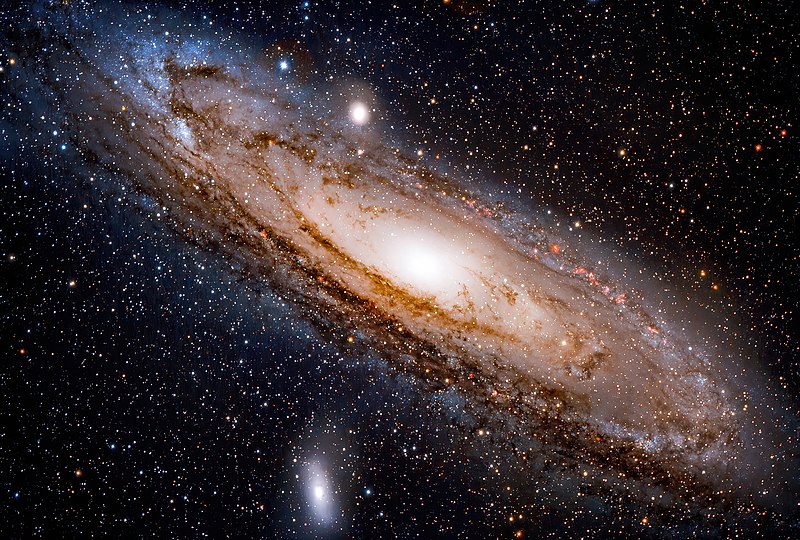
- The Milky Way is a barred spiral galaxy, meaning it has a central bar-shaped structure and a spiral shape. It is estimated to be about 100,000 light-years in diameter and contains between 200 and 400 billion stars.
- The Milky Way is part of a group of galaxies called the Local Group, which also includes the Andromeda galaxy and about 44 smaller galaxies.
- The Milky Way is thought to have a supermassive black hole at its center, which is called Sagittarius A*. This black hole has a mass of about 4 million times that of the Sun.
- The Milky Way is surrounded by a halo of dark matter, which is a type of matter that is not visible but is thought to make up about 85% of the matter in the universe.
- Our solar system is located in the Milky Way, about 27,000 light-years from the center of the galaxy. The Sun is just one of the billions of stars in the Milky Way, and it is located in one of the galaxy’s spiral arms.
- The Milky Way is moving through the universe at a speed of about 550 km/s (342 mi/s) relative to the cosmic microwave background radiation, which is a faint glow of radiation left over from the Big Bang.
- The Milky Way is home to a number of different types of objects and phenomena, including planets, comets, asteroids, nebulae, and star clusters. Some of the most famous features of the Milky Way include the Orion Nebula and the Andromeda Galaxy.
- The name “Milky Way” comes from the appearance of the galaxy when it is viewed from Earth. From our perspective, the galaxy appears as a faint band of light in the night sky, which looks like a milk spill.
- The Milky Way is classified as a Type II Seyfert galaxy, which means it has a very active nucleus that emits large amounts of radiation. This activity is thought to be caused by the supermassive black hole at the center of the galaxy.
- Scientists believe that the Milky Way formed about 13.6 billion years ago, shortly after the Big Bang. It is thought to have evolved over time through the merging and accretion of smaller galaxies.
- The Milky Way is not the only galaxy in the universe. In fact, it is just one of hundreds of billions of galaxies that are thought to exist. Some of the most famous other galaxies include the Andromeda Galaxy, which is the closest major galaxy to the Milky Way, and the Sombrero Galaxy, which is a large, massive spiral galaxy located about 28 million light-years away.
- The Milky Way is thought to be surrounded by a massive halo of dark matter, which is a mysterious substance that does not emit, absorb, or reflect light and is therefore invisible to telescopes. Despite its name, dark matter is thought to make up a significant portion of the mass in the universe, and it plays a key role in the formation and evolution of galaxies.
- The Milky Way is home to a wide variety of objects and phenomena, including star clusters, nebulae, and celestial bodies such as planets and comets. Some of the most famous objects in the Milky Way include the Orion Nebula, which is a massive cloud of gas and dust that is actively forming new stars, and the Crab Nebula, which is a supernova remnant located about 6,500 light-years from Earth.
- The Milky Way is a barred spiral galaxy, meaning it has a central bar-shaped structure and a spiral shape. The galaxy’s spiral arms are made up of stars, gas, and dust, and they are where most of the galaxy’s new stars are born. The Milky Way has a total of four spiral arms: the Scutum-Centaurus Arm, the Sagittarius Arm, the Perseus Arm, and the Norma Arm.
- The Milky Way is thought to be about 13.6 billion years old, which is roughly the same age as the universe. The galaxy formed shortly after the Big Bang, and it has evolved over time through the merging and accretion of smaller galaxies. Scientists believe that the Milky Way is still evolving and that it will continue to change and grow over time.

